
Blog · Family trees
How to record co-wives and half-siblings in a family tree
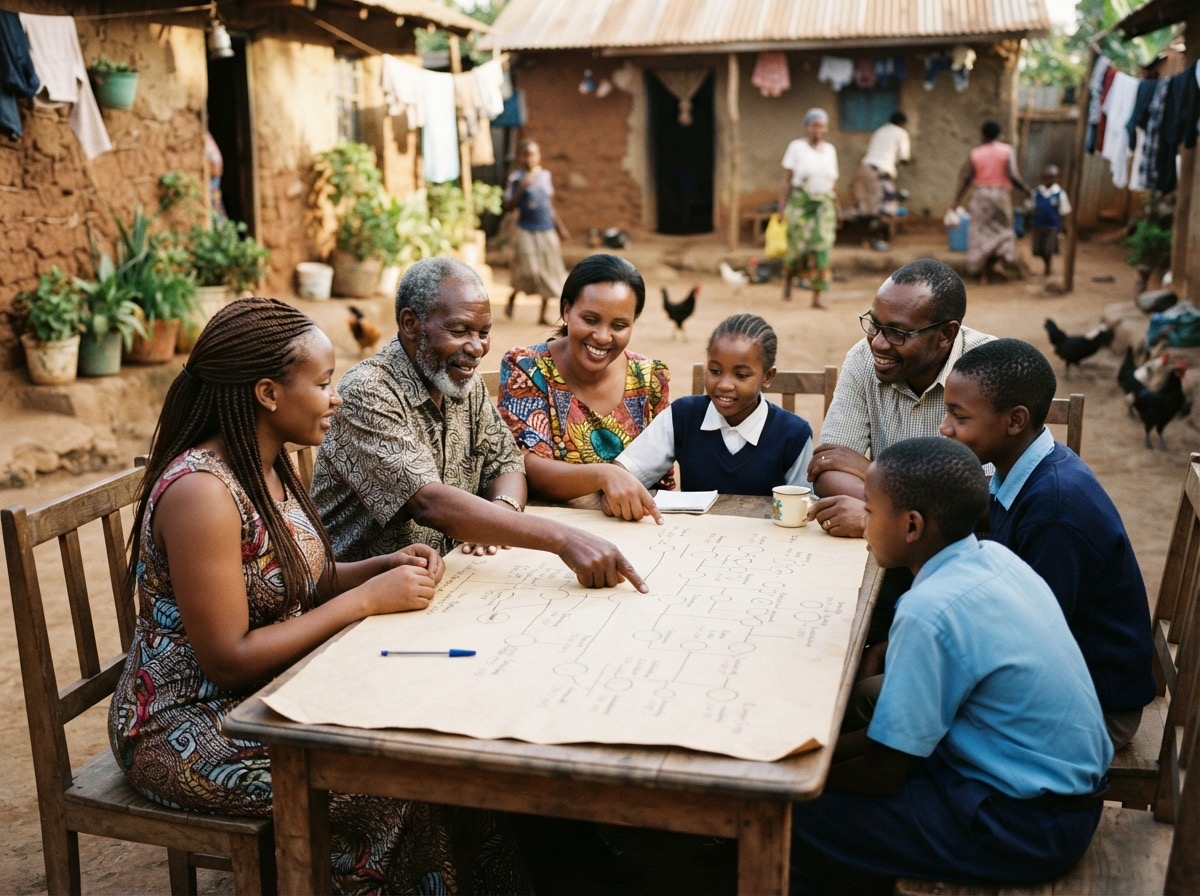
Many Kenyan families do not fit the neat picture of one father, one mother and their children. A man may have had two or three wives. A woman may have had children with more than one husband. Some children were raised by an auntie or a grandmother. If you try to draw all of that on a sheet of paper, the lines soon cross and somebody feels left out.
This guide shows a calm way to record it all, so that every person is in the tree, every child sits under the right mother, and nobody is hidden to make the picture tidier.
First, some plain words
- Full brothers and sisters share the same father and the same mother.
- Half-brothers and half-sisters share one parent only. Maybe the same father but different mothers, or the same mother but different fathers.
- Co-wives are the women married to the same man. In many families they are also called the houses of the father: the first house, the second house, and so on.
- Step-parents and step-children are not related by birth, but are family because of a marriage.
A family tree records two things: who was born to whom, and who was married to whom. Keep those two things apart in your mind and the rest becomes easy.
Step 1: Give every wife her own place
Start with the father. Write his name in the middle of a sheet of paper. Next to him, write each wife, in the order he married them. Give each woman her own box and write her own family name too, because mothers and grandmothers are half of your story.
Do not squeeze two wives into one box, and do not leave one out because the marriage ended or because the family rarely speaks of her. If she was married to him, and she had children with him, she belongs.
Step 2: Put each child under their own mother
This is the step that makes everything clear. Under each wife, write the children she had with that man, oldest first. Draw the line from the child to their own mother, and from the child up to the father too.
Now each mother has her own little group of children, and the father stands over all the groups. Anyone looking at the paper can see at once who are full brothers and sisters (the same group) and who are half-brothers and half-sisters (the same father, a different group).
Step 3: Do the same for a mother with more than one husband
If a woman had children with a first husband and then more with a second, give each husband his own box beside her. Put each set of children under the right father. Her children from both marriages are half-brothers and half-sisters to each other, because they share her.
Step 4: Add the people who are family without being born into it
Children raised by an auntie, a grandmother or a family friend can be put in the tree in two ways, and you can use both. Show who their birth parents are, because that is the factual record. Then write a short note beside their name saying who raised them. Both are true, and both matter to that child.
Questions that help you get it right
Ask an older relative these, and write down the answers as they speak:
- What was your father's full name, and how many wives did he have?
- In what order did he marry them?
- Which children belong to which mother?
- Did any of the marriages end, and did any of the women have children with another husband?
- Who raised whom?
Ask kindly. Some of these questions touch old feelings. If a person would rather not answer, write down what you do know and leave a gap that can be filled in later. A gap is better than a guess.
Mistakes to avoid
- Leaving someone out. A child who is left off the tree will notice, and so will their children.
- Calling a half-brother "a cousin". Use the real relationship. The tree is a record, not a verdict.
- Mixing up the houses. Always draw the child's line from the child's own mother. If you are unsure whose child someone is, ask before you draw.
- Forgetting the dates. Write the year of birth, and the year they passed on where it applies, under each name. Dates stop two people with the same name from being mixed up.
Doing it on your phone or computer
Paper is a good place to begin, but a long family needs more room than one sheet. In Album, you open the father, press the pencil, and press Add another husband or wife for each wife. Married people appear side by side with a heart between them, and lines run from parents to children. For a half-brother or half-sister, you open the parent they share and add a child. When a man has several wives, you choose the child's mother, so that the child sits in the right house.
If you are only adding the family around you, a few easy steps will do. Open the person's panel, choose Child, Husband or wife or Brother or sister, and type the name. The new person is put in the right generation for you. If a grandparent is not in the tree yet, a parent with no name is added to join them, so your auntie still shows as your auntie, and you can name that parent later.
Check your list
- Every wife has her own box, in the order of marriage
- Every child is drawn from their own mother and their father
- Children raised by someone else have a short note
- Years of birth, and of passing on, are written under each name
- Gaps are left open, not guessed
If you are only starting, read how to make a family tree, step by step first, then come back here when you reach the father's wives.
Every family is a little different, and a tree that shows all of it is the one your grandchildren will thank you for. Album puts your tree, photographs and stories in one private place for your family, and you can look around the demo album to see how a tree with several wives is shown.