
Blog · Family moments
How to write a life history (obituary) for a funeral programme
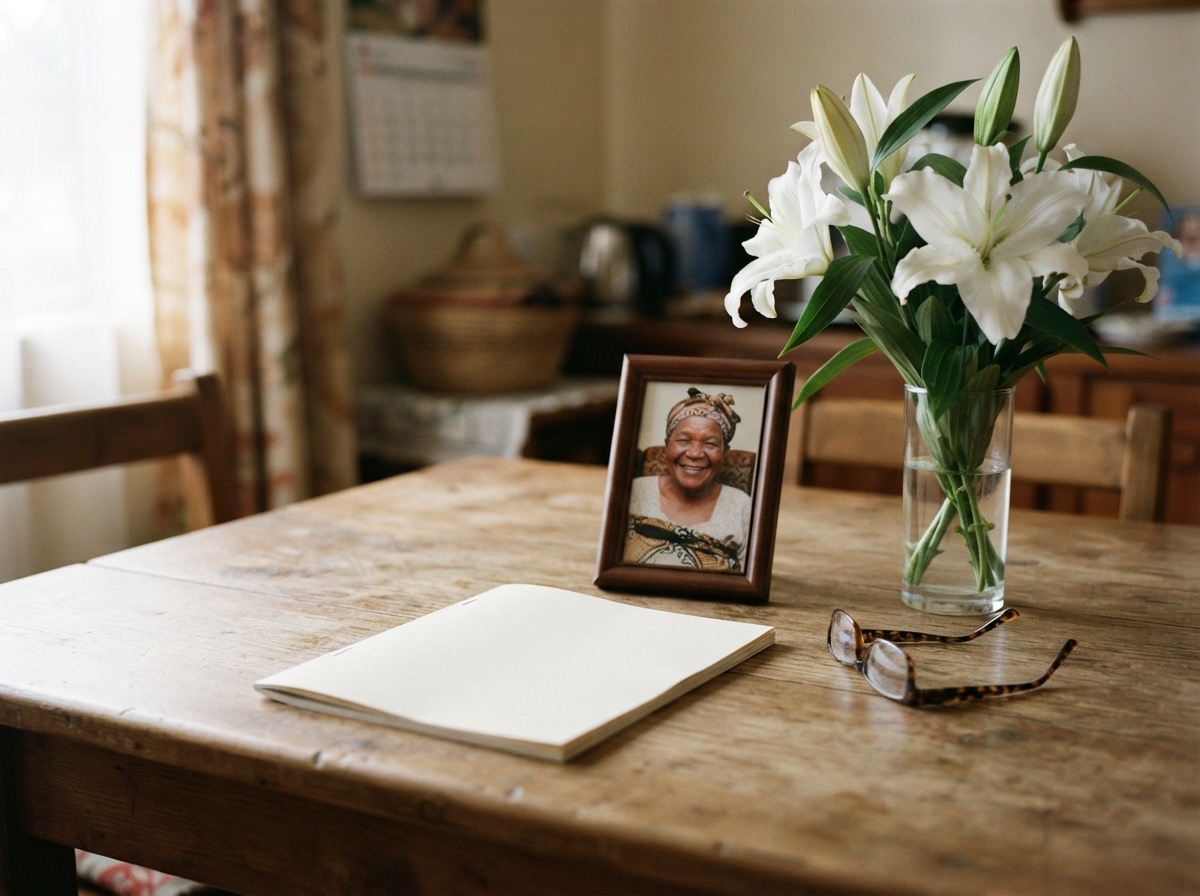
The life history is the page of the funeral programme that tells guests who the person was. Some families call it the obituary. It is usually read aloud near the start of the service, so it needs to be clear, true and short enough to read in three to four minutes, which is about 400 to 500 words.
You may have one evening to write it, while the family is grieving. This guide gives you a plan so you are not facing a blank page.
Step 1: Gather the facts first
Before you write a single sentence, collect the facts. Ask the closest relatives and write down:
- Full name, and any names they were known by.
- Date and place of birth, and their parents' names.
- Schools attended, and any training or qualifications.
- Work: jobs, the business they ran, the farm they kept, or the home they looked after.
- Marriage: the spouse's name and the year, and the names of their children.
- Faith and community: their church, mosque or temple, and groups they belonged to.
- Passions: what they loved doing, and what they were known for.
- The date they passed on, and, only if the family wishes, the cause.
Then check every date and every name with a second person. Names and years are what guests remember when they are wrong.
Step 2: Put it in this order
Most life histories follow the life itself, from beginning to end:
- Early life. Born on a date, at a place, to two parents. Growing up, and school.
- Working life. Where they worked and what they were proud of.
- Family. Marriage, children, and later grandchildren.
- Faith and community. What they gave to others.
- Character. Two or three things that made them themselves.
- Final months and leaving. One or two gentle sentences.
- Who they leave behind. Spouse, children, grandchildren, brothers and sisters.
Step 3: Add what makes them real
A list of dates tells guests when, but not who. For each part, add one small true detail. "She worked as a teacher" becomes "She taught Standard Four for twenty-two years and could still name most of her pupils." Ask relatives for a saying they used, a meal they were known for, or a habit that made everybody smile. One detail in each paragraph is enough.
Step 4: Use gentle, honest words
Write "passed on", "left us" or "went to be with the Lord", whichever the family uses. Say the cause of their passing only if the family agrees, and never in a way that blames anyone. If someone's life was hard, you do not need to hide it, but a funeral programme is the place for what the family wants remembered.
A short example
Life history of Grace Amani Baraka
Grace was born on 4 March 1951 at Kapsabet, the second of six children of Peter and Ruth Baraka. She attended primary school nearby and trained as a teacher in 1971.
She taught for thirty-one years, and many of her former pupils are in this church today. In 1975 she married Juma Amani. They had four children, Neema, Salim, Hassan and Imani, and later eleven grandchildren, whom she loved to feed.
Grace was a faithful member of her church choir for forty years. She was known for her laugh, her vegetable garden and her habit of keeping everybody's birthday.
She passed on peacefully at home on 12 October 2026, aged 75, surrounded by her family. She leaves her husband Juma, her children, her grandchildren and her brothers and sisters.
Before you print
- Read it aloud once. If you stumble, the reader will too.
- Ask one person who knew them well to read it for mistakes.
- Check the length against the page in your programme. Our funeral programme checklist shows where the life history sits.
- Keep a copy as a file, not only on paper.
Keep it after the funeral
The life history is often the best summary of a life the family will ever have, yet after the service the printed copies are lost. Save your final text in a document and share it with your brothers and sisters now.
In Album, your family's private album on your own web address, you can keep the life history as a story next to their photographs and the family tree; look inside a demonstration album.